Sunday, October 25, 2009

Around Town

Some memorable images recently taken around Lugazi...

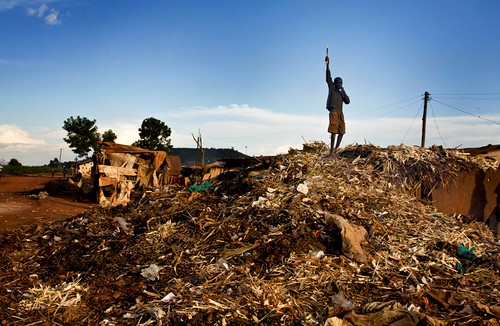
You won’t see lions or elephants in Lugazi, but trash is ever present with children usually playing in it.


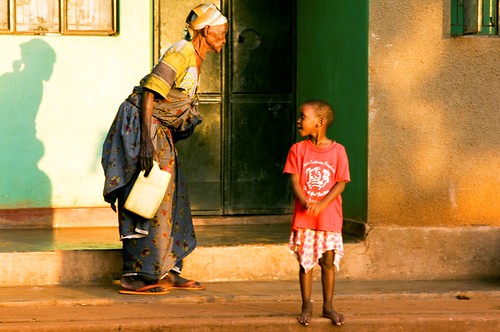
A young girl in front of her home and an elderly caretaker.


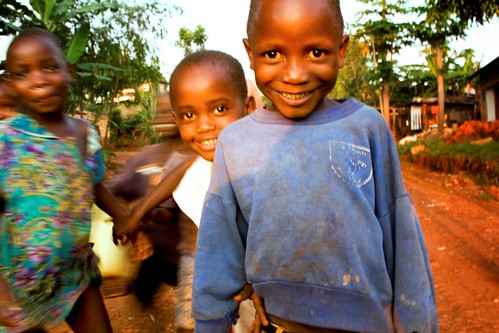
I am the Pied Piper of Lugazi, particularly when camera is in hand.


More children lured to the lens.


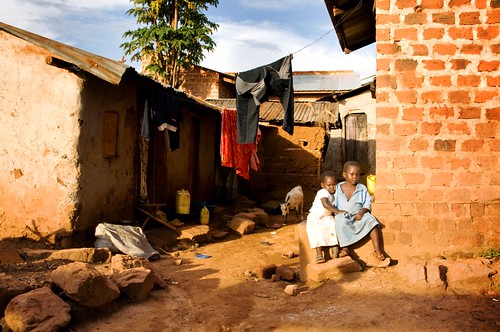
Two little girls resting in their front yard with the ubiquitous hanging clothes and a goat, livestock and chickens are almost as common as refuse.


Friday, October 23, 2009

Lots of Little Pills

It is winter now in Uganda. Winds sweep massive dark clouds along the low cerulean horizon, gusts stir light plastic bags and wrappers, floating them gently through the air as leaves overhead rustle and women pull their blown shawls closer to their shoulders. Fortunate children wear their school sweaters over their uniforms, v-necks in solid colors. It's autumnish. At times blustery.

Long sleeved shirts still hang in my closet, neat and unworn; it’s still too hot for me to cover up. Here it is winter, but it’s tropical winter; reminiscent of a seasonal fall, but the underlying humidity and heat remains. My arms and legs still stick together from perspiration, my tank top and shorts still damp with persistent sweat.

With the coolness and storms comes coughs and sniffles. I am fighting a chest cold as are each one of the children. They pass viruses between each other constantly, from the little ones to the older ones to their school friends and back again, but the winter ushers in stronger strains of sick that rattle little bodies longer and harder, and the rainy season also brings more malaria.

Right now Agnes has it. She got treatment yesterday. Rachel had it a few weeks ago, but is fine now, although she burst open her chin again yesterday running at school and falling on a bench and paid yet another visit to the hospital. I think that is number five for her in the past month.

And yesterday Sylvia had a follow up test for the malaria and typhoid she was being treated for last week; malaria gone, typhoid still there, so back on the white capsules she goes.

“Sylvia. Do you know why you had to get injections and have to take pills?” I ask the little one so completely terrified of needles. When they inject her buttocks, tears pour down her scarlet puffy face and she screams OOOHHH-WEEEE! OOOHHH-WEEEEE!

Her eyes wide, she shakes her head.

“You had to get an injection because you have typhoid. Do you know how you got typhoid?” She tilts her head not sure how to answer. “You got typhoid because you drink dirty water. Remember Mommy told you not to drink dirty water? You only drink water that has been boiled. You don’t drink water out of the jerrycan.” I knew the girl drank unclean water at times; she had reached for the yellow container of well water once in front of me to pout into her cup.

“Did all of you hear that? You don’t drink dirty water if you don’t want to get sick, if you don’t want injections. And typhoid is very dangerous. Sylvia could be much sicker than she is,” I lecture all six kids one afternoon at their house, looking carefully at their faces making sure they are getting me. They are about to eat. I watch Agnes dish posho and beans into wet bowls.

“And you dry the bowls and silver wear before you use it. You pour food into a bowl still wet with dirty water or use a spoon that has dirty water on it, you can get typhoid.” I turn to look at Aggie to see if this makes sense to her. Her eyes seem bright, she nods her head. What we take for granted not growing up poor and ignorant in the village, I think.

Beatrice has managed, despite the weather and her poor hygienic habits, to avoid typhoid and malaria and is doing okay, except for congestion in her chest and fungus on her head. The telling light patch emerged on her shorn scalp the week before last, but will take the treatment of an oral tablet and topical ointment for another week. B2 is not alone in contracting a moldy scalp; discolored heads are commonplace in Uganda with parents maybe not having the money or the patience for the Western medications, so local herbs and remedies are often administered, which are only marginally helpful.

Richard has dodged ailments of all kinds, but still suffers with the leg. Calls and meetings with the surgeon at the charity hospital has us still waiting in purgatory; no we are still not sure if we will have all the instruments we need for him. Mobilizing for Plan B, I will be taking him to a hospital in Kampala next week to meet with doctors who can perform the surgery. In the meantime, a swab of the wound showed the bacteria only sensitive to Cirpro, so Richard takes a large white pill each morning and evening to combat the infection.

The kids' medications are purchased and administered with extreme caution. There are no safe-guards here; nothing in place it seems to protect people from unscrupulous dealers in medicine. I learned the tricks of the trade quickly; how to create one’s own African medical insurance.

“Let me see the dates,” I always ask the pharmacists before they sweep the tablets and pills from the large container into the customer-sized white paper sachets (child-proof plastic containers with medical warnings and labels a world away). Expired medications linger on shelves like mosquitoes on curtains. I check the dates on the bulky jars. I check where the meds are made. India’s okay. China, no way. On the paper packets of pills, I write the patient’s name and times to be administered: Sylvia, 8am, 4pm, 12am; Richard, 7am, 7pm; Beatrice, 8am, 4pm, 12am; Sylvia, 6am, 12pm, 6pm, 12am…. And on and on.

Sunday, October 18, 2009

Fetching Water

As the sun sets and Ugandans prepare for their evening meals, the dirt roads leading to and from watering holes, springs, wells and public taps are crowded with people, mostly children, fetching water. Even those as young as four can be seen carry yellow containers, jerrycans, filled with amaazi in their strong grips and more often on their heads. They don't seem to mind their burdens, usually performing the dusk ritual as they laugh and play. The chore itself as well as the child labor, both so utterly foreign to me, are a source of personal fascination and yet another lesson in gratitude.


Tuesday, October 13, 2009

Encounters by Possibility

I had been losing hair. Not in huge, alarming clumps as if pumped with a high dose of chemo, but too many strands were covering my pillow in the morning, sticking to my wet hands in the shower, falling across my shoulders throughout the day. And my head was like the Prince William Sound circa 1989, I was half expecting to find slick black pelicans and seal corpses in its depths. I had bought a couple of brands of African shampoo; clearly none were made for muzungu tresses; the cleaning agents just waxed my head, sealing in the grime and pollution.

Muzungus! Muzungus! I called to two young American-looking women I saw across the street beyond the lorries and taxis that choked the road. The unusual light figures in long colorful dresses disappeared behind a slow moving semi. I needed a consult about my hair. The women were fast-moving and obstructed by careless African vehicles; a break in traffic, I dodged to the other curb feeling as usual when crossing thick African roads like Froggert.

“Hi!” I exclaimed running up beside them, trying to tamper the inherent awkwardness of the situation: rushing to strangers on the street, out of breath, looking slightly desperate, needing to talk to them simply because they were white. They paused slightly surprised to see another muzungu in Lugazi, but only faintly distracted from what seemed to be an important task. “How are you?”

“Fine.”

“I’m Natalie. I’m staying here in Lugazi. My hair is falling out. I think it is from the plaiting. Have you been losing yours?” I looked to the taller woman who had woven long black braids into her scalp, conveying authentic Africaness, making her light blue eyes even more striking.

“No. But I just got this done.”

“Oh. And I can’t find any shampoo. Where have you been buying your shampoo?”

“We brought enough with us, but there is Pantene at that Gapco over there. I’ve seen it.”

“Really!? Great! I’ll go there and get some.” I was so relieved. They smiled and asked what I was doing in Lugazi. They were with HELP, an international volunteer organization.

“Oh. Well. I am here by myself. I am staying with a family of a friend of mine over there.” I pointed to my building on the other side of the road, at the edge of the clearing about 150 meters away. “I am looking after some orphans I found. What are you doing here?”

“We are working on a few projects in town. We are coordinating with a local youth outreach group and the town council.” The African infused woman was holding a large corrugated box. She shifted the heavy item in her arms against herself stomach. “We are sort of on our way to the hospital. Can we walk and talk?”

“Oh! Yes. Sure.” I took the opportunity to further explain how I came to live in Africa and how five orphans came under my care. I didn’t stop talking for several minutes; it was the first time I had interacted with Americans in person for a few months. I could hear myself rattling on, rattling on; not realizing how much I wanted to speak familiarly, without cultural misunderstandings, ironically with people who were just strangers.

“Why don’t you come and see the work we are doing sometime?” The non-braided woman asked.

“Yes. I would love to,” I gushed. I looked at the business card she handed me; her name was Melissa.

“She’s Kristen,” Melissa said pointing to the other woman as she walked a few feet from us about to enter the hospital property.

“Great. Well. Thank you. I’ll call soon.”

A few hectic weeks passed. I was enjoying African tea and fried eggs on the veranda of my Kigali guesthouse. Chiba and I were leisurely taking in the already brilliant morning, relaxing before heading to the congested taxi park to board an African bus flying over African roads for ten hours; a mild form of torture. Then a familiar pale face emerged in the shade, the bright early light flooding behind her.

“Melissa! It’s me! Natalie. I met you in Lugazi a few weeks ago. I am the one that ran to you about my hair falling out.” She looked back in amazement, smiling, recognizing me.

“I can’t believe you’re here!”

“I know! What a strange coincidence! Of all the guesthouses in all of East Africa .” We spoke about our projects for a few minutes then Chiba and I rushed off. It was decided between us muzungus that we would see each other once back in Uganda .

The HELP muzungus were already nearing the end of their four month service in Lugazi. I only visited their large gated house once before the evening they were returning to America . Kristen decided in her final days that she wanted to start a non-profit with some of the widowed and vulnerable women in town; it would be a beading co-op and the community organization she had been working with that summer, The Youth Outreach Mission (TYOM) would manage it and ship the finished jewelry for her to sell in the U.S. I told her I was willing to help her during the remainder of my stay.

“Great. Can you take some pictures of the women and interview them?”

Of course.

So on the muzungus’ last day in Africa, I moved through town taking pictures of the women in their co-op and attended an event they organized under the shade of the vast mango tree in the town centre; it was a launch of a new product: ABLE soap. The soap was made by a local group of disabled persons with the proceeds helping them meet their special needs. Another NGO has been contacted and was providing free wheelchairs; white, plastic lawn chairs fitted within black aluminum bars attached to durable wheels resembling mountain bikes were lifted from the back of a large lorry and set in the grass; persons pulling their lame limbs with thick wooden sticks, or using their hands to guide their disfigured frames across the ground gratefully climbed into the new devices that would lighten their heavy lives. The turn-out for the event was impressive; dancing, smiling, ease; it was an African gathering.

Unloading wheelchairs at ABLE Soap launch

This is where I first met some TYOM members. I would meet more at the muzunugs’ going-away party that evening.

It is interesting to reflect on first encounters with people who change your life, to recall the moment when they were a stranger whom you thought would pass like most, as an indistinguishable guest in your journey, but with whom you would eventually develop a special, indelible, remarkable relationship of growth, understanding, and nurturing between each other; sparking the same within yourself.

I don’t remember anything in particular, any words or glances exchanged that were memorable, any clothes, facial expressions or actions that stand out, but my impression of this group of young Ugandans was that they were deeply committed to serving their community, and that they were genuinely kind; the muzungus gave farewell speeches to TYOM members their final night in Africa; we would be friends for a lifetime; we have learned so much working with you; we have been so inspired by your passion and compassion. The Americans words were sincere and heartfelt, painting a picture of a group of Ugandans who were gentle, but hard-working; compassionate, but strong; busy, but committed; in need, but sacrificing; ambitious, but honest; assured, but humble; idealistic, but reliable; they were a group of big dreamers with big hearts driven to make a big impact.

I met with TYOM members the following week to coordinate the work I was doing for Kristen. Falling into a navy blue plastic chair in their cramped office I told them about my own project: my children. What was I going to do with them? I didn’t think I could afford to build them a home. What project could I create for them in Uganda to sustain them?

“Natalie. You know. This is what we do. We help the community. We started wanting to help the children,” Robert, a TYOM co-founder and orphan himself, explained to me.

“Yes. If you could help, that would be wonderful,” I said, thinking they might assist in raising the chicks that would be a part of the poultry farm project I was just beginning to pull together; I didn’t realize the extent of the young volunteers’ capabilities.

“We have business proposals. We even have ones for a poultry farm and a snack shop, we were working with the muzungus this summer on the plans,” Robert said, a permanent easy grin etched on his dark face.

“Really? That’s great. I would love to take a look at them.”

Over the course of the next few days, Robert, James, Godfrey, Sandra, Paul, Dennis and Wilson surprised and impressed me over and again; their business plans for a snack shop and chicken farm were thorough and detail oriented, including prices for every possible variable and fixed cost input; some of the TYOM team even lived in the village of Enkoko, which is Luganda for chicken, they lived and breathed the poultry business; they created coordinated, efficient and sustainable business proposals with thoughtful management structures; and, what’s more, they were fantastic with the children; Godfrey often gave them a few hundred shillings to buy sweeties; Robert fawned over them; Sandra danced with them; James tutored them; TYOM members loved children, especially mine.

Sandra hugging Rachel in village

And the kids have returned the affection. All of the children, the two little ones, Beatrice, Peanut, Richard and Agnes are ecstatic to spend time with their uncles, usually hanging around the TYOM office until the evening before having to return home for supper.

“You are their favorite people in the world,” I said one late afternoon to Robert and Godfrey as the girls ran to greet them shrieking and crawling on them. “Honestly, they wouldn’t be as happy to see Alicia Keys or Barack Obama.” The young men started laughing; they knew it was true.

I am especially pleased about the uncles’ relationship with Richard. The boy is friendless and surrounded by women; his life is saturated with estrogen; he has African and muzungu mommies, five sisters (including Peanut), and all of his neighbors are women or girls. The young men at TYOM serve as important male friends and role models to the boy who casts off his clingy shroud of anxiety and unease when in their presence; I look over at Richard when we are at the TYOM office, or moving through town with our posse of uncles; the boy’s face is relaxed; he seems safe; he looks joyful.

Richard smiling at Robert

And so it was these series of chance encounters, prompted by a bout of dirty, breaking hair that lead to my finding exceptional people to entrust with my children’s financial and general well-being; to my meeting a group of young idealist to help me develop sustainable projects for my little orphans and to possibly, and very probably, serve other vulnerable children in Lugazi sometime soon. I marvel at the twists that have lead to our paths crossing and at the potential laying at our feet; just yesterday Robert described his vision for our projects merrily, but very seriously: “We want to do something extraordinary.”

Richard playing with my little girls


Friday, October 9, 2009

Home Coming

“You know the kids’ father hasn’t come by Namengo recently and at least the last two times he has come, he hasn’t brought food. In fact, he’s been eating the kids’ food.”

“That’s not good,” Stephen replied vaguely, focused on rushing out the door. I stood next to the breakfast table staring at the flask of steaming African tea. It was hard to find time to speak with Stephen; most of his days are spent in his village near Jinja; farming the land, managing the help, remodeling the house. He often leaves early and doesn’t return until late, sometimes just in time for our midnight suppers.

“And I’m worried the kids will lose their land. You know the father could die or disappear and we wouldn’t know it and his family could steal the land the children are supposed to inherent.” Lawless Africa meant such things: stolen inheritance, pilfered land, unprosecuted crimes, muddled justice.

“Yes. We need to get a will,” Stephen confirmed, searching the room fervently for misplaced items. “I told him he was to bring the children food when we first took them.”

“I know, but it’s been at least two months since he’s brought anything.” I hoped my words resonated, that our conversation would lead to imminent action.

“Okay. I will go and talk to him,” Stephen assured me as he grabbed his muddy gumboots and fraying sac and disappeared out the door.

A few evenings later Stephen wound through the sugar cane on the back of a boda to the children’s father’s village; Stephen arrived on the remote plot after nightfall; the father’s mud house stood in the dark silence; the father was nowhere to be seen. After ten minutes the father appeared with paraffin in hand, apparently not thinking to get the needed fuel for his lantern during the day; the man had nothing to look after but himself, and still he was hopelessly careless and irresponsible.

“You bring food for the kids this Saturday,” Stephen had directed him. The man claimed he had been doing so. He insisted he brought his children a bag of cassava.

“Yeah, he did bring cassava. Like two months ago,” I rolled my eyes to Stephen when he recounted their interaction to me; I wasn’t letting the father get away with his usual manipulation.

“I also told him to come and see me Sunday and we will discuss how to handle the children’s land,” Stephen said; words ushering in a great deal of relief.

The children’s expenses were mounting. It was costing more to look after them than I had anticipated. And what was I to do with them when I returned to the comforts of America? I couldn’t possibly send back all the money they needed. How could I develop a sustainable project for them? Who could I entrust with its management? Ugandans are infamously corrupt. Here is a culture of stealing. I could invest in a piggery or a poultry farm and leave it with someone who exuded honesty, who smiled genuinely and sincerely assured integrity, who appeared to care for the children and be dedicated to running the business for their profit, but find after several months the investment looted, the manager gone and the children shillingless.

But it had been a week of breakthroughs: I had found the Youth Outreach Mission (YOM), a local community organization, to develop and manage the sustainable projects for the children and to assist in looking after the children’s general welfare; and, I was on the road to securing the father’s land as the children’s food source and inheritance. Weight lifted.

The father did come the weekend after Stephen paid him a visit; the imprudent man actually arriving with food in hand as golden Sunday afternoon light flooded through the Balaza’s thick, dirty windows. Stephen reclined on the yellow couch, speaking with the father at length in Luganda then turning to me. The father had two pieces of land: the one he resided on, which would be passed onto Richard upon the father’s passing; and an undeveloped plot nearby his homestead, which would be given immediately to all of the children.

“I told him to go back to the village and mobilize. Get everyone there this Saturday at two,” Stephen told me. It was decided we were to host a village gathering at the father’s house to introduce the children’s new caretakers (Ester, YOM members and myself) to the villagers (the local counsel, village elders and children’s relatives), to firmly establish the children’s plots as their rightful inheritance and to make clear that the undeveloped land would be farmed beginning immediately exclusively for the children.

The next few days were spent organizing; food stuffs purchased, plates and cookery secured, transportation organized, YOM schedules cleared for a full Saturday of cooking in the village; firewood would be fetched; water gathered and boiled; large, flimsy, metallic pots filled with posho, rice and beans would be stirred over open flames; food preparation without any modern conveniences for fifty people is time-consuming, back-breaking difficult work.


Sandra, YOM volunteer, cooking for villagers


About eight YOM members arrived in the children’s village early that Saturday morning to begin preparation for the afternoon meeting. The gathering start time was standard for villages; enough time to finish before dark and sufficient time for villagers to finish their morning digging, a chore they couldn’t allow to go neglected, ensuring nourishment for the coming months, otherwise people could go hungry.

I arrived in the village under a washed out sky packed next to Beatrice on the back of a boda; Ester shared a small motorbike with the two little ones and Peanut; Aggie and Richard were squished together on a third bike. Most of the villagers were already gathered around the father’s mud clearing, some men resting on the benches, most women and children lounging in the dirt; some women in traditional gomesi; most of the village’s half clothed children running excitedly through the fields, staring at me, giggling; soft Buganda greetings were exchanged. Olyotya. Jendi. Kali. Nawe.


Children and old women at village gathering


The crowd grew together after almost an hour, the local council chair intimating he was about to speak. As he spoke in gentle Luganda, Ester translated in hushed tones at my side. The father then stood to offer his words about the children’s inheritance, followed by Robert, who spoke of YOM’s commitment to helping manage the children’s finances and well-being. All of the speakers acknowledged the children’s development; they looked much better; thank you for your care. All agreed that the children’s due land would be passed onto them.

Richard (in red) addressing the villagers


Finally I spoke, telling the villagers of how I came to help the children, and what I intended to do after returning to America. I didn’t say we took the children because their father was too ignorant, selfish, dim-witted and callous to properly look after them; I said it was too difficult for the father to raise them after their mother passed; I can only guess the villagers understood the truth of the matter, that they were familiar with the father’s character and his negligence; just earlier that week some of the villagers saw Sylvia and Rachel in town and began talking to them, I had asked Ester what they said to our girls and she replied, “They said their father was just sitting in the village doing drugs.”

Our party then rose and followed the father as he led us away from his house towards the undeveloped plot some 300 meters away. We walked across the thin dirt road, behind a decrepit brick house, through a serene wide clearing and down a lush jade slope. The father stopped and gestured to the land at our feet, sweeping his hands to the top of the hill. This was it. This was the land all five children would inherent. It was about two acres and to my untrained eye, hinted bountiful potential. The YOM members, Ugandans, therefore inherently knowledgeable about farming, eyed the plot, already initiating their plans to develop it for the children. They assured me my assumption was correct; yes, the plot is very fertile.

We headed back to the father’s house where the father and local council would document in writing the dimensions of the plot and the children as its rightful owners. I leisurely strolled through the sweeping countryside with my children, taking photos of them and their village friends reunited after weeks apart, many smiles, skipping, laughter. Filled with a sense of gratitude and accomplishment, I took in the juxtaposition; my now joyful, healthful, scrubbed, loved children set against the same village setting I first encountered months ago.

Rachel posing in the field near their plot


We continued to walk. Pallid grey-blue squeezed heaven and earth, rendering the atmosphere indistinct, nearly surreal; but, the mood was one of tranquility, tenderness and security. The children and I relishing the afternoon’s sense of peace and its promise of the fruits to follow.

My Kids, Big Sky!


Rest of the Village Meeting pictures here.

Sunday, October 4, 2009

Picture of the Day

Markets like this one line the road between Kampala and Jinja. When vehicles stop, it's a free for all; vendors swarm, stuffing arms through the windows with their goods, insisting that you buy water, meat on sticks (which I never take), gnuts, gonja (roasted bananas which I often do take) and various types of produce.

I liked this shot because it also conveys Uganda's virtues; wide, easy smiles; relaxed, friendly greetings; casualness and community; Africaness.