Friday, September 4, 2009

Snapshots

I was staying at Aunt Vinnie’s in Kampala, recuperating from another illness, seven of her eight children were packed in the three bedroom house; sleeping in bunk beds, on couches, on homemade mattresses on the floor; two of the children are usually away at boarding school, but were out on holiday making the already crowded house overflowing.

I reached for something on the dresser in the room I was sharing and an old photo caught my eye. A grinning woman with a baby face and sparkling eyes was knelling down in a fashionable seventies jumper with a tamed afro, a light-skinned familiar baby staggering to stand at her side, on the other side of the baby sat a slight girl on her knees, barely in her teens, her hand stretched out as if she just released the child, hesitant eyes and a dark complexion, the girl also familiar. I studied the photo for a moment and smiled; I recognized the faces: my Ugandan Mummy, a young Margaret, content and eager, looking barely past a child herself; at her side, her baby Timo virtually the spitting image of his now 2 year old daughter, Anique; and my kids’ mother, Alice, looking the same age as her oldest daughter, Agnes, now, both pretty, petite and slightly shy. I knew much of these three people’s lives, what had happened to them since the photo was taken just over 30 years ago. Could they have ever imagined a mzungu from America years in the future would come to know them so intimately? I marveled at the moment snapped decades ago so capturing their spirits and foreshadowing their lives and that of their children.

“Their mom first ran off when she was in P4,” Margaret told me after I told her about the photo, asking more about my children’s mother.

“She ran off just in P4? How old was she?” I asked knowing that a child of about age 10 would be in P4.

“Not old. She had just started to get breasts. And she ran off with a man. I think she wasn’t good in school and she kept having to repeat, so she was somehow frustrated,” Margaret explained, her face contorting as she tried to find the words to explain the difficult situation.

I imagined my kids’ mom years ago, maybe 14 years old and still in P4, far away from her village, her aunt and uncle trying to offer her a life her own parents could not, but she felt stupid, maybe not very interested in studying, many girls didn’t attend school in those days.

Apparently my kids’ mother did this a few times: would disappear with an older man then come back to the Balazas to try and continue school and get her life together, then run off again. She had had a child with another man and left him with the father’s family. The Balazas told her she couldn’t keep running off with different men, that she needed to settle down, and she did settle down, but not with the ideal; the father of my children proving to be notoriously neglectful, selfish, and abusive.

But somehow, somehow married to a man who most likely passed HIV onto her through his extramarital affairs, who stole her ARV drugs ensuring she didn’t receive proper treatment to control her illness, effectively killing her, who would sell all his crops in town and leave his wife and daughters with nothing to eat, who drank and did local drugs, somehow my kids’ mom, Alice, raised five beautiful, thoughtful, considerate, grateful and caring children.

There’s the oldest, Aggie, seemingly so much like her mother in looks and temperament, but wiser. Before her mother fell ill, the Balazas tell me Agnes was becoming interested in boys at the expense of school.

“I think since she cared for the mother as she died, Agnes has changed,” Margaret and Stephen tell me. I tried to insert myself into her life; living in a mud house with soil for floor, cooking little food on a charcoal stove outside, entering the wet house to serve your mother as she slowly wasted away, dying before your eyes as four younger siblings look to you for parental support; I could see the situation’s gravity weighing down and instilling a seriousness, focus and maturity.

Agnes is 15 years old and is at once baba, the word for the eldest sister who has taken on a maternal role; cooking, cleaning and caring for the children; and still part child, befriending the other girls in P5 with her, girls three years her junior, laughing at cartoons, making silly faces at the camera.


I remember the day that we took the kids from the father. We sat in the clinic waiting for the HIV test results of the two youngest, Sylvia and Rachel. I told Agnes all of them would be going back to school; her face lit up.

“What do you want to be?” I asked her. She frowned not understanding, her English exceptionally poor. “You want to be a teacher, a nurse, a doctor, what?”

She brightened again, understanding me. She looked to the ground, fidgeting and smiled, “I want to be a nurse.”

She would make a good nurse, she is considerate and responsible. But she is behind in school like her mother was. I hope she has the strength and stamina her mother did not to finish the years of schooling required to realize her dream. But at the very least, she is happy now and is not solely responsible for four younger siblings.
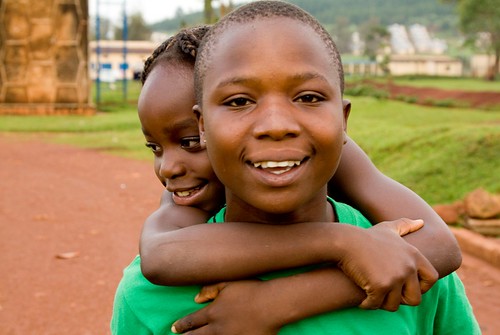


Following Agnes is Richard, 13 years old; the only boy in the family, the one that had to walk on an infected tibia for nearly two years, the leg enlarging over time as new bone grew over the dead and decaying part leaving him permanently deformed. He has a stoicism I have never seen before, forced upon him by the obvious pain he has endured in the leg and by the pain in his heart; his father repeatedly told him to deny hurt, and the lameness has affected his ability to make friends.


Richard is sweet, but hardly talks, his father had often separated him from his sisters, and since their home was somewhat isolated, Richard I am guessing grew up with little social interaction. When spoken to by me, his family, strangers, it is nearly above a mumble. He sort of looks down and talks, but if you show him particular attention, ask about his school work, congratulate him on correct answers, tell him he’s done something well, thank him for mindfully doing his chores, a beautiful, huge, toothy smile spreads across his face.


After Richard is Beatrice, or B2 or Ajambo. She is eleven. Of the five mild children she is the most even-tempered, the most easy-going, being a good younger sister to Aggie, listening to her and minding her, and being a responsible, caring older sibling to the youngest two. When we went to the open-air market recently and I searched through the vendors for a new dress for Rachel, and it was B2 that most wanted to help find a new dress for her little sister, and the most eager to show the present to Rachel.


B2 always genuflects when she greets me, a custom the central Ugandan tribe, the Buganda, follow to show respect to their elders. She smiles so easily, gets along with everyone all the time, and is always glancing at me and Ester and her jah jahs watching what we are seeing, wanting her best to behave. She’s also very active. I come to their house in Namengo and always see her playing with the other girls in the dirt next to their home; throwing balled up pieces of plastic bags turning them into balls, trying to peg each other with it, jumping and dodging.


Sylvia is the second youngest and is seven years old. She is sweet like the others, but seems to suffer some from middle child syndrome. She’s not the baby of the family, nor does she have the elder respect the other two girls enjoy. She is the most emotional, usually greeting me by running to me with a huge smile, Mommy! Mommy!, throwing her hands over her delighted face, covering her eyes wild with excitement when I greet her back, so happy she can’t even look at me. She is often quick to whine and cry when she doesn’t get her way, pouting and throwing her hands in the air when the older kids get the soccer ball before her, or when another hits her during play. She seems the most vulnerable, but tries nonetheless, working hard to get her backwards numbers and uneven letters correct; running to do my wash when she seems me attempting to clean my clothes by hand.


“Mommy! Mommy!” She shrieked as she sloppily wrung a sudsy shirt over the basin in our shower room, a move sure to not clean the clothes properly; she was imitating my childish attempt at hand washing, which left her in hysterics, sporting a big grin, with adult teeth in a little mouth, gapping in parts waiting for more mature teeth to follow.


The baby of the family is four year old Rachel. When I first found the girl she was desperately sick: belly bloated with worms, face infected with a rash, chest rattled with a cough. With some treatment and love she has transformed into the single most happy child I have ever met; she laughs, giggles, bounces, coos, smiles, shrieks, contorts her face into all angles of delight, the most amusing of which involves her curling out her tongue.


She is constantly hanging on me, constantly playing with others, she loves her older sisters and brother, she loves going to school, she love her new home, she loves her life. I imagine she was perpetually ill prior to coming under our care, during her entire short existence she probably didn’t know what it felt like to be healthy, now that she is disease-free she is reveling in the new found incredible feeling of good health.

She is usually overjoyed, but it’s obvious when she needs a nap, when it’s time for kwebaka. She becomes a little obstinate and her eyes flutter. I’ll grab her and bring her to the back room of jah jah’s to lay down, sometimes she yields, other times there are tears, but she always falls asleep. And when she’s tired she won’t greet people.

“Say ‘I am fine.’” I’ll instruct her to reply to a greeting from an elder and she’ll just look down, trying for avoidance. I’ll repeat myself, maybe ask her a third time, finally her little lips will move and you can almost hear it: I am fine. Everyone just laughs, staring at the girl with amusement. Even when stubborn she is delightfully cute and fills your heart with love.

Rachel carrying a doll on her back like African women carry their babies.


Sunday, August 30, 2009

Images of the Everyday: A Lesson in Gratitude

Cooking

Cooking is almost always done on a charcoal stove making meal preparation a time-consuming and tedious task.


Dishes

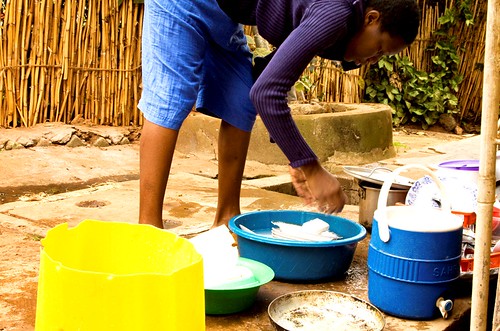
Dishes are, of course, always done by hand.


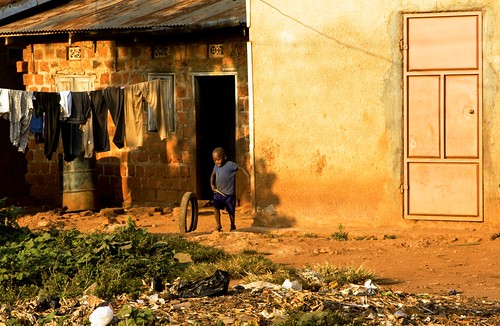
Laundry

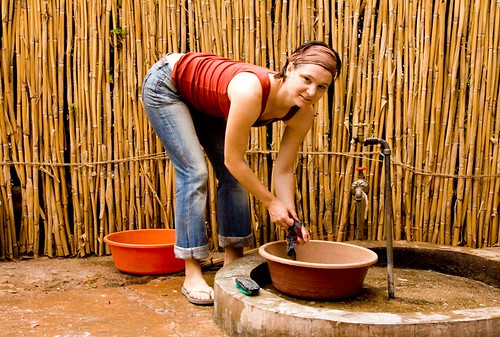
Hand washing clothes is painstaking and annoying. Laundry machines are nonexistent so washing is always done by hand.

-


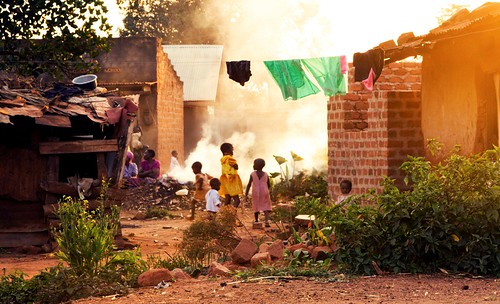
And always hung to dry... drying clothes seen everywhere.


Security

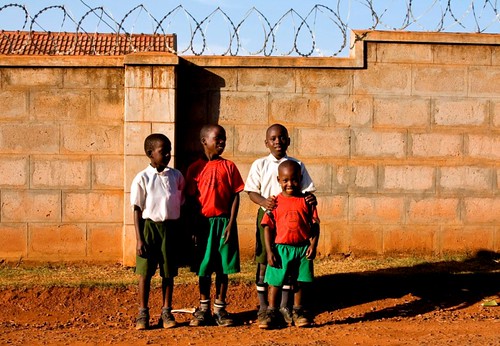
Nice homes, as in not of mud and plain brick, must have barred windows...


... and high, secured walls.


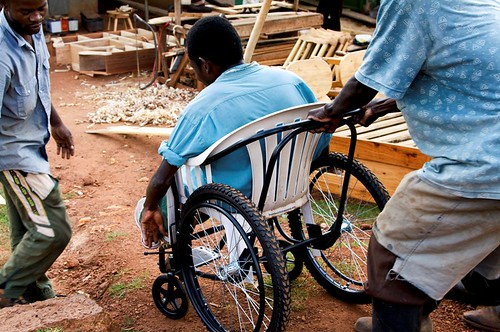
ADA

This lucky man received a donated wheelchair; most of the disabled lean on large sticks to move themselves around or literally crawl on the ground.


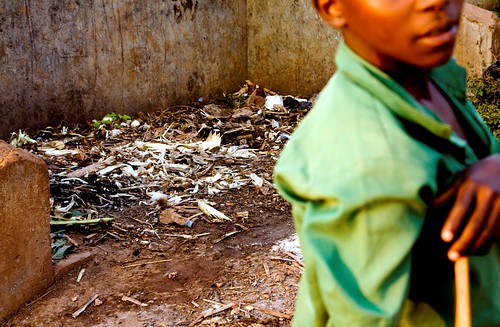
Drainage

Without a modern sewer system, drainage and waste is a part of life.


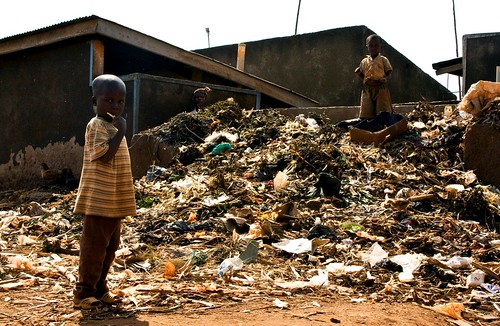
Trash

Trash, trash everywhere. Kids play in it, livestock and poultry eat from it.


Play

Except for the occasional flimsy soccer ball or cloth doll, most kids play with what they find.


Tuesday, August 18, 2009

In the Comfort of Children

Mama Mzungu TB, this is my full name to the children.

It started really with the cough that rattled Sylvia’s body when we first got her, which took weeks and a few rounds of treatment to finally cure.

“We keep giving you drugz, but it’s not going away,” Ester had told her.

Sylvia became wide-eyed and silent.

“Don’t scare her,” I said to Ester. I turned to Sylvia, patting her back.

“Don’t worry, you’ll be okay.”
Sylvia’s cough finally cleared, but then Beatrice, B2 or Ajambo as named by her siblings, developed one. The threat of TB was gone, but lingered in the backs of their little minds.

“Ajambo TB! Ajambo TB!” Sylvia shouted to Beatrice.

B2, forever gentle and sweet, responded merrily bashful; her dark lips trying to cover her easy bright smile. Rachel saw that I was slightly amused and was encouraged to continue teasing her sister. I looked at the little one.

“If she’s Ajambo TB, then you’re Baby TB.”

The kids thought it was the funniest thing they ever heard. I pointed to each of them: Sylvia TB, Ogola TB, Agnes TB.

I patted my chest: Mama Mzungu TB. They lost it.
“Mama Mzungu TB! Mama Mzungu TB!” Rachel cheered falling over herself with uncontrollable laughter.


The kids are unrecognizable superstars of their former ill, neglected selves. And my experience in helping with their transformation has confirmed what I always knew to be true, being a parent, or at least attempting to be a good one, is, besides maybe being the President, the hardest job imaginable.

The feeding, bathing, schooling, tutoring, treating, supervising, disciplining, coaching, guiding, and loving is as rewarding as it is challenging; made all the more difficult in a developing country without running water, without two parents, with uneducated, little minds and a language and cultural barrier.

I will tell them something and hear, “Yes, mama,” but it’s not done. Did they misunderstand me, or are they just doing what they please?

“You bring Rachel’s medicine in the morning to jah jah’s on your way to school.”

“Yes, mama,” Agnes politely replied to me.

The next day, the drugs never arrived. Probably lost in translation. But.

“You be at jah jah’s after you get up – by nine. Get there right away,” Ester had told Richard one morning. It was quarter to ten and we needed to be at the hospital. Where was he?

Tired of waiting at jah jah’s, I fetched him at the children’s home in Namengo, about a 15 minutes’ walk from where I stay. The boy was not ready; for some reason he decided to clean his uniform after he was supposed to leave. I knew he understood Ester speaking to him in Luganda, so what was he thinking?

Another day I found one of the Balaza’s forks hidden in his book.

“Why did you take this?” I asked him as we stood by the road. He muttered something about Sylvia. I told Ester.

“Yeah, they are picking things from their jah jah’s. The other day he hid a hanger in the back of his shirt and I found it in Namengo,” she said vaguely discouraged as she twisted a client’s hair in her shop.

I was concerned, but understood why they were taking the trivial and mundane. They had nothing before. A fork was a big deal, to own a hangar unthinkable.

And there were mild mendacities slowly emerging like sly fungus.

Agnes had come to jah jah’s one afternoon for lunch. Stephen sat at the table watching her eat and asked her why she wasn’t taking food as she normally did at school. She said they didn’t have lunch that day; a thinly veiled, sophomoric lie.

Ester, the Balazas and I decided it was time to have a chat with the kids. We set the boundaries now.

“I don’t want you children lying and stealing! You listen to your mamas and jah jahs! And you need to keep this place clean! Do you hear me? Look at this mess! You behave or I do to you what I did to little Jennifer!” Stephen directed them one night in their tiny home; beatings and their threat standard African child discipline.

The children, thankfully, seem to have heard jah jah’s words. We haven’t noticed things going missing in the house, I haven’t caught the children being untruthful; their teachers say their behavior is improving.

“Yes, Rachel is well behaved now. Now that she has motherly love,” the headmistress told me recently as I fetched the youngest of the clan and her report card, the school term just ending.


Rachel’s marks were the best of her four older siblings as to be expected since her simplistic schoolwork basically involves matching pictures and letters. The others are far behind.

"Oh good! Good, good, fairly good, good, good, fair, fairly good. This is good, Sylvia.” I congratulated the second youngest as she hung on my lap smiling with gapping teeth. I was looking at the first page of her report folder, handwritten reviews of the girl’s performance in areas such as letters, numbers, and verbal English. Behind the report card were pages of her work. But it was virtually all wrong: insequencal letters, incorrect addition, misspelled words. I laughed to myself shaking my head. The headmistress wanted to promote Sylvia to P1, the first level in primary school after next term since she was already too big for nursery school. She wasn’t ready. None of it was good.

Richard and Beatrice were doing fair at best in P2 and Agnes was totally failing P5. It’s not that they weren’t trying. Their teachers acknowledged their desire to learn. At least they try. Only Agnes could spell her name when they came to us after all. With school out for three weeks now was an opportunity to play catch up. I needed for them a private tutor.

“Yes, I will tutor Agnes and we’ll get another for the other three. It’ll be 50,000 for each teacher. They will go to school from eight to three for the big one and until after lunch for the others,” Agnes’ English teacher had told me.

I agreed enthusiastically. Fifty dollars for three weeks of almost a full day of private schooling was a good deal for me and the extra money welcomed by two lucky teachers.

The Monday after their regular classes ended I brought the kids to the school. The teacher for the three little ones wasn’t there yet. Agnes entered the regular class held during holiday, sitting with the other children; her private lessons apparently not starting promptly. This is Africa, I calmed myself.

I came back at eleven to give the children some food; they only took porridge for breakfast and I knew they would be hungry by late morning; they needed nourishment for concentration. The kids were out of class lounging under a tree. I went to find their teacher.

"They are taking a thirty minute break. We go back to work then they’ll be home for lunch at one,” the teacher assured me. Okay.

The kids entered the house at quarter to one. As usual, Beatrice proudly showed me her schoolwork without my asking; a page of math, two pages of English.

“Where’s the rest of it?” She looked confused. I called for Ester’s sister, Carole, in the kitchen to translate.

“She says that’s all they did.”

“WHAT?”

Carole repeated herself.

“What about you, Richard? You show me what you did today and you too, Sylvia.”

Richard opened his exercise book to one page of math and one of English. Sylvia had only a matching letters exercise; I had rage.

“This is what they do with a private tutor for five hours!”

Carole chuckled smugly.

I tore back to school, walking with the exercise books in hand, recalling Margaret’s warning that she would locate a tutor because people are funny and will take your money and they won’t help the kids; fiery Irish temper making my head swim.

I greeted the headmaster and stuck the pages under his nose, showing him the pathetically small amount of work. Like Carole, he laughed, and asked one of this staff to walk me to the woman who was supposed to be mentoring my children.

“It’s the first day. We can’t do much the first day,” she said with a big smile on her face.

“You only did one page here. This is not ‘not much,’ this is nothing!”

The woman said something about the children playing.

“I am not taking them here to play. If I wanted them to play I would have kept them at home. I am paying you to teach them!”

“Okay,” the woman still said grinning, not getting why I was mad, probably also amused by the silly, angry mzungu. “Tomorrow we will do more.”

“Yes, you will do much more or I am getting my money back!”

I walked back home and slopped matoke and gnut sauce in my bowel. I chewed not tasting the food; Agnes came through the door.

“Hi Aggie. How was school?”

"It's good."

“Can you please show me what you did?”

She pulled one exercise book from her bag and flipped it open to the first page half-way filled with neatly written math problems in ink.

“Is this all?”

“Yes.”

“Did you do English?”

“Yes.”

“Anything else?”
“No.”

I called for Carole again.

“She says that’s all they did,” Carole translated for me even more amused than before. She, a former teacher, was undoubtedly well aware of the ethics lacking in the profession.

I could feel my blood rising past simmer.

“Ask her if she was alone with the teacher or if she was with the rest of the class?”

They spoke. Then:

“She says she was with the other kids.”

I threw my hands in the air.

“Can you believe this? They are stealing from me! People here see mzungu and all they want is money. This doesn’t happen in America. If you pay somebody to do something, they do it. I was afraid this would happen.”

I looked at Agnes. Her face was sour.

“I’m not mad at you, Agnes. I am mad at your teachers.”

I stormed out of the house again, this time to confront the Agnes’ teacher, the one who called me friend and asked why I hadn’t brought him back anything from Rwanda, the one who had suggested that he tutor the kids in the first place. He wasn’t at school or his home across the street. I went for the headmaster again.

“Hi, sebo,” I greeted him friendly, but agitated. “Will you look at what Agnes’ tutor did for five hours today?”

This time he wasn’t amused.

“This is not good. And this is bad for me too,” he said concerned; the first I’d seen the jovial man humorless.

“Yes, I am sorry to bother you, but this is not what I am paying them for. They are not serious.”

“No, they are not serious. You gave them 100,000? 50,000 each?”

“Yes.”

“Okay. You get your money back and I will have two teachers who will tutor the children tomorrow. Be here at eight.”

“Thank you, sebo. Seba burrungi.”

I strove towards home, blood pressure slowly lowering, relieved by the headmaster’s rightful alarm and intervention, but still irritated; after months of acclimation, of living with Ugandans, of becoming familiar, my surroundings and experiences were losing their novelty and I was fraying under Uganda’s corrupt culture. Where are the morals? Can I trust anyone?

Within there is a growing disturbance, I am endlessly questioning virtually everyone around me; my relationships are inextricably compromised, my relations defined by my having infinitely more; I am a have, and they have-nots; the have-nots assume with the wave of a magic mzungu wand I can extricate them from poverty’s absurdity and mire; I, the have, come from a society dazzling rich with money and transparency and truth, and they, the have-nots, have developed in a culture poor in every respect, wrecking their country and minds; I am never quite sure what someone is asking of me, never certain what one is prying from me, never clear of the intentions behind the mask; I, the have, and they, have-nots, all of us are all aware of what I have they not; my relationships with almost everyone, both those close and distant, those common and strangers, rests on this. It is tiresome. Very.

My oasis from this stress, from walking the streets harassed by passersby, from acquaintances pushing their items or services, from familiars lamenting their financial problems, from street children trying to swindle my shillings, are my own children: Agnes, Richard, Beatrice, Sylvia and Rachel. I don’t worry about what their attempting to squeeze from me, or what their kind actions conceal, or what they are covertly asking, or what their intentions are in saying this or telling that. They just love me and appreciate me, as well as each other. They quite simply are refreshingly themselves: happy, healthy, sweet little kids relishing their second chance at life.

Saturday, August 15, 2009

Rwanda Rising

Welcome to the Unexpected

"It’s so clean here. The streets are so nice. The air so fresh.” I gushed constantly the first three days to Chiba, my Ugandan cousin and travel companion; I think she was starting to get annoyed.

I felt a world away from Uganda. Rwandan roads are neatly paved unlike the pot-holed abominations of their northern neighbors. There are actually sidewalks lining most streets, a piece of trash can’t be seen for kilometers, cars and lorries don’t choke the air with exhaust, uncountable loitering people don’t fill the walkways and clearings; I didn’t feel like I was in Africa.
Rwanda is patient, organized, disciplined, somewhat boring; even Kigali shuts down by nine. Vehicles behave well; driving in their well-marked lanes, not speeding and overtaking; the bodas all have helmets. The land without trash has banned caveras, plastic bags, and the law’s actually enforced. When we crossed the border, Rwandan authorities checked our baggage and politely took the cavera Chiba had tucked behind a pair of shoes. We don’t have these here.

I could sense right away that what I had heard of Rwanda was true: they don’t tolerate corruption. I could actually see foreign aid and domestic investment going to work: paving roads, stocking clinics, building schools, not lining fraudulent pockets. The discipline and honesty inspires and gives hope to the continent. And it makes the corruption in Uganda even more blatant, elucidating its negative effects. I would look around Rwanda and think, Look at what Uganda could have if the government served its people like this.

Mass grave at Kigali Memorial; 250,000 buried below

Traveling through Rwanda today, it’s difficult to believe the genocide occurred here. The people are as soothing as their air; only a couple of children’s calls: Mzungu! Mzungu! In Uganda nearly every child tries to greet me and oftentimes boisterous young men do the same; occasionally harassing, usually friendly, but always loud. Rwandans are as gentle and reserved as their traditional dance, a series of gliding gestures, soft and friendly, the woman moving with arms spread to their sides bowing and sliding, nodding and smiling like swans in flight.

“They are a humble people,” Chiba had assured me when we arrived in the capital.

The capital, Kigali, rests nearly in the country’s dead-center. It spreads itself over a series of steep hills; fresh streets, shiny structures and pretty parkways climb and descend the sleepy city. The atmosphere reminded me at moments of a Southern California mountain town; the dryness, terrain, flora and calmness not what I expected. I anticipated the densely tropical, thickly hot and African chaotic. Instead, a mountainous breeze swept past my skin and through the peaceful valleys, gently rustling the lazy eucalyptus and pines overhead; soothing equatorial heat.

The current political wind pacifies the land too, attempting to blow away the country’s infamous tribal tensions. Decades of hatred between the Tutsis and Hutus coalesced in an apocalyptical slaughter fifteen years ago, leaving a stain on the country, the region, and the world’s conscious. It lingers, but has become an impetus for change.

“There are two tribes here, right? But you speak one language?” Chiba had asked a Rwandan, trying to grasp the region’s unusual historical sharing of a single language between tribes.

“No. There is one tribe,” the woman said firmly, holding up a single finger. Chiba and I exchanged a glance; we understood what the woman was telling us.

As explained to me by a Rwandan close with the Balazas whom I met in Kigali, tribal differences remain, but are conducted secretively as they are acknowledged to be amoral and are even illegal. Tutsi parent’s may not want their children marrying Hutus and vice versa, but preferences are not always enforced, and if they are, are generally done covertly. One tribe may have a bar that is a hang-out, an area that is known to be theirs, but boundaries are mostly unsaid and the society is working hard to erase their divisions and nightmarish past. Hutus and Tutsis work and live side-by-side, they sometimes inter-marry; they are fighting for justice and forgiveness despite decades of animosity percolating below the surface unseen by visitors, but divulged in cover of darkness, in the confines of friendship.

Beyond Hotel Rwanda

Hotel Des Mille Collines. Hotel Rwanda. The famous hotel. The famous movie.


It is still an operating hotel in the center of Kigali and is actually larger than it seemed in the film. The movie communicated to the world a story very much deserving to be told, the actions of a courageous Hutu who risked death hiding over a thousand Tutsis and moderate Hutus in the hotel. Larger than art, the film has metamorphosed into more than cinema; it is now how the world understands the Rwandan genocide, how the public seems to relate to all of Rwanda. But Hotel Rwanda, despite its paramount artistic integrity, is not the complete picture of the holocaust, and certainly not all that is Rwanda past and present.

As historical background to the genocide, the Belgians colonized Rwanda and exacerbated the differences between the Hutus and Tutsis by issuing identity cards and favoring the minority Tutsis, offering them better educational and employment opportunities. Upon the country’s independence in 1962, the Hutus assumed power and enacted revenge against their brother tribe through subjugation and smaller, lesser known genocides. Many Tutsis fled their home during these decades to neighboring countries, including Uganda. These Tutsi refugees as well as some moderate Hutus came together to form the Rwandan Patriotic Front (RPF), which grew in power in the early 1990s and sought to overthrow then Rwandan President, Juvenal Habyarimana.

Then, on April 6, 1994, President Habyarimana’s plane was shot down over Kigali airport. It is still unclear who shot it: the RPF, or extremist Hutus who wanted to blame the RPF as an excuse to begin the slaughter, most believe it the latter. Regardless of who killed the President, it was an impetus for mass death.

Beginning the night the plane was shot down until mid-July of 1994, nearly one million Tutsis and moderate Hutus were murdered while the world largely stood and watched; nearly 20% of the nation’s population; 10,000 murdered every day, 400 every hour, 7 every minute. It is estimated that about 300,000 Tutsis survived the genocide, including thousands of HIV-positive widows, many of whom were subjected to genocidal rape by men known to have the virus. The genocide also left about 400,000 orphans with nearly 85,000 of them becoming heads of households.
Visiting the genocide memorials and speaking to Rwandans creates a vivid picture of those horrifying weeks. My previous impression of the genocide, namely through the movie, was that innocents were murdered quickly by machete and bricks, but in reality the killings were much more ruthless; they were horrifyingly gruesome. Killers would torture victims, entering neighbors’ homes to maim the parents, cutting off legs and arms in front of the children, leaving them to suffer and returning a few days later to finish off the adults and kill the young. They would even crucify and impale, bury people alive, dump victims into pit latrines stacking them until they died under the weight of falling bodies or the thrown rocks, only stopping when the cries ceased.

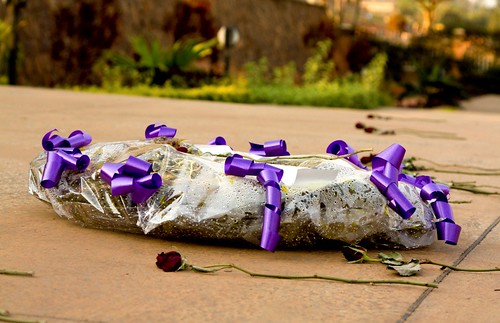
Wreath and flowers at mass graves at Kigali Memorial

The Kigali Memorial is a museum dedicated to the country’s dark past. The bottom rooms describe the historical context, and contain some footage of the massacre as well as interviews with survivors. The upstairs contains countless pictures of the deceased, photographs donated by their living relatives. A section is dedicated to the children. Larger than life photos of children line the walls with a placard describing them underneath: their names, their likes, their last words, how they died: an infant burned to death in a church, a four-year old liking spaghetti, a two-year old murdered by being thrown against a wall, a seven-year old last heard saying “UNAMIR will save us,” a ten-year old tortured to death.

The survivors will say they have no idea how they endured; it was mere luck, an act of God. Few were blessed with a courageous Hutu that hid them, chancing his or her own life to save another, but most fled. Families would part and run for cover, generally unable to hide together as the roadblocks strategically placed around Kigali and the entire country prevented it. As such, the youngest were destined to die, unable to run through the bush by themselves. My Rwandan friend tells me the youngest survivor running alone that he heard of was seven.
I close my eyes and imagine April 1994. Cries fill the night around you. Your neighbors are being slain by other neighbors gone mad, carrying machetes and stones and bricks. You sit in your dark home surrounded by frightened sisters, brothers, mothers, fathers, aunts, uncles, grandparents and cousins gripping each other awaiting death. You hear the murderers closing in and you flee, but you must go in separate directions. You don’t know where you are headed, you have to move undetected through the bush that night and for many thereafter, dodging killers, avoiding roads, eating and drinking whatever you find. If you survive vigilant, murderous eyes, and starvation, dehydration and disease in the bush, you may stumble upon another country or the army’s advancing line and end up in a refugee camp to languish there not knowing the fate of loved ones. The situation would soon be made worse when your killers arrived as they ran from the army they feared would enact revenge, or when cholera swept through the population, attacking the poorly-managed, deathly destitute camps.
The killers were virtually everyone and anyone. Tens of thousands, maybe even hundreds of thousands. Children even killed. My friend told me of a survivor in the Mille Collines watching children raping and killing a woman from his room. Placards at the memorial describe a child attempting to murder a neighbor, one he played with every day, one like a brother to him. Families would kill their own, especially in mixed clans. The two Tutsi-looking children of a mixed marriage were slaughtered by aunts and uncles, while the Hutu-looking kids might be lucky enough to survive; fortunate enough to grow up with the guilt of outliving their siblings slaughtered by their own caretakers.

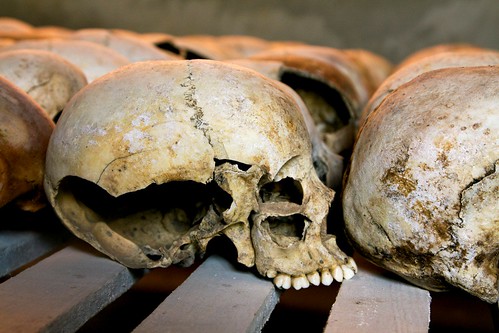
skulls at Murambi Memorial


As I walked the streets of Kigali and drove through the villages, I would look at people and wonder where they were during the killing. Were they here in Rwanda? Or were they already seeking refuge in a neighboring country? The people my age would have been about 15 or 16 years old during the genocide. What did I do at that age? School dances, soccer games, getting a driver’s license, going to parties, sleeping in class. While I danced, played, drove, partied and slept, the Rwandans my age whom I saw in cafes and the fields, at market and the bus stop, might have murdered or been hunted, watched their family members kill or be killed, walked around bodies littering the ground or buried the dead. What had I done with my life since my mid-teens? University, jobs, love, friends, birthdays, Christmases. I think of the thousands of lives lost before they could experience this, before they really lived.

I considered this too at the Murambi Memorial in Gikongoro, a former technical college resting alone on a hill just outside the nondescript town. Chiba and I reached Gikongoro via bus from Kigali in the late morning, and asked a boda to take us the memorial; a creeping eeriness descending upon us as we fell down the dirt road and peered through the eucalyptus at the striking countryside, not knowing where we headed, unsure of what we would see. A white jeep passed us with a mzungu in the back, staring out the window, a memorable expression on her face: regret, forlorn, shock, hurt.
A brick building lay before us. In front of it a small sign and a large clearing. The scene was empty and alone, save the white fence on the far sides where dozens of children hung and watched. Were they looking to see our expressions as we left? An enormous military helicopter was parked in front.

The memorial was off the path traveled by most tourists making it a somewhat obscure destination. It lacked the sense of a formal remembrance center besides the entrance sign and reception desk; it felt like an abandoned set of buildings lying to waste on the hillside forgotten.

As we approached the entrance, a woman spoke in hushed tones to Chiba, joining her by hand as we wound around to the back side towards a series of smaller brick buildings, beyond us the flowing, terraced mountains of Rwanda; austere beauty.
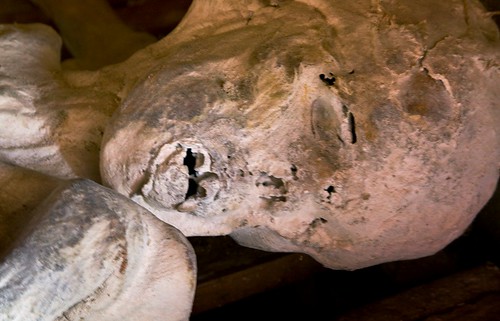
The woman walked us to the first block, stood back and raised her hand slowly for us to look into the room. It was maybe fifteen feet square with wooden grated tables about three feet high occupying almost the entire room save a small walkway in the middle. On the tables lay dozens of white decomposed corpses partially preserved in lime. The bodies resembled the work of a macabre artist, moldings of paper mache, twisted frames of powdery pale cake; some were big, some were babies; some still sprouted brittle hair, some still swaddled in decaying cloth; some recoiled in hopeless defense, others memorialized in grotesque torment; legs were hatched off at the knee, heads blown wide open, torsos missing appendages.
We moved silently from room to room, the unique bitter odor filling my nostrils, the sight and smell forever seared into my mind. We came upon the only other group of visitors, distinctly British. The older woman’s eyes and lips pulled downwards vaguely, her hands and eyes fluttered; the stoic’s attempt at hiding sorrow and regret. An older man snapped photos with a click-and-shoot; I glanced back at the guide to ensure taking photos was permitted, wanting to respect the dead and grieving. She nodded and swept her arm encouraging me.

Room after room we took in the dead on display. Approximately 50,000 people died at Gikongoro’s technical school, only a small fraction, about two hundred are preserved in the memorial, most buried beneath the ground forever. All of the children and staff at the school perished as well as the nearby villagers who ran to the blocks for safety.

We entered the old dormitory block, a huge empty space save a wall filled with the dead’s crumpled possessions: mattresses, blankets, clothes, shoes, bowls, cutlery. I believe it was here that our guide whispered to Chiba. Two of my children died here.

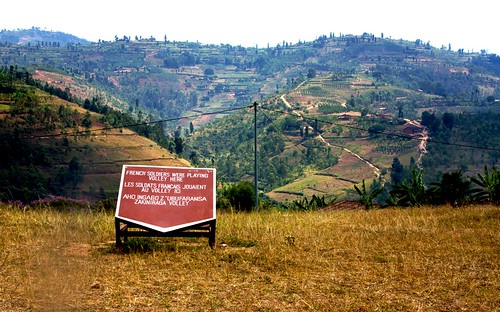
She walked us down the slope towards the far side of the property, about 50 yards away the first set of houses lay below us, two children ran up to me from them and asked for money. I looked at another placard before me, The French played volley here. I didn’t fully grasp the purpose.


They walked us down another 15 yards then I saw a series of other placards: Mass Graves of Victims. I now understood the placards.

On June 22, 1994, with no end of the blood-shed in sight, the UN green-lighted the deployment of a French peacekeeping troop to secure areas in southwestern Rwanda as safe zones for fleeing Tutsis. The operation is now generally regarded, except for by the French, as a move to provide haven not for hunted Tutsis, but instead for the murderous Hutus escaping retribution from the advancing RFP; the French were giving protection to the Hutu militia groups they had been covertly siding with and arming all along.
There are assertions that the French were actually at the technical school in Gikongoro watching as Hutus slaughtered 50,000 of their fellow countrymen. Whether the French were there as it happened, or arrived immediately afterwards remains difficut to determine, but regardless, the extent of French culpability in the genocide was eye-opening: arming the militias that roamed the country killing hundreds of thousands, harboring those same murderers in Operation Turquoise under the guise of peacekeeping, and denying their involvement to this very day.
Chiba and I filled out the visitor’s guide solemnly. Dark children still lined the bright fences outside. We joined them in watching the Brits board the military helicopter parked in the clearing, staff and members from the House of Parliament flying back to their lives in London; returning to a place far from the hills of Rwanda where death rots in the soil. I looked at their notes in visitor’s book. I am sorry we didn’t do more.


To Clementine
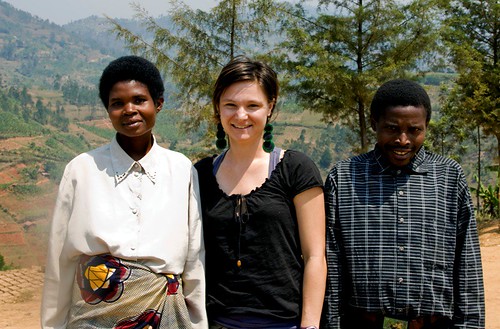
Clementine is a survivor of the Rwandan genocide. She is married with three children. Like many rural Africans, she is very poor, can’t read or write, lives in a hut without water or electricity, and barely farms enough to feed her family. I have known Clementine for almost one year. She is my sister through Women for Women International.
Women for Women International is a fantastic organization based out of D.C. that offers holistic services to women in war torn countries. For one year the woman receive lessons twice a month on issues such as health, sanitation, women’s right and domestic violence. They also group the women regionally into co-ops, which produce goods sold for profit, such as a piggery or craft-making. Through their co-op the women learn marketable skills and how to manage money, some funds going back to the group and a portion lining each woman’s pockets every month. When I signed up to sponsor a woman last year, I requested to sponsor a woman in Rwanda. Clementine and I had written each other once; she didn’t know I was in Africa.
The day I arrived in Kigali I was determined to find the WWI offices. I researched the internet, it wasn’t listed, but I found a photo. It was a picture of the Rwandan office’s sign, and it had a phone number. I called and called, my cell phone not connecting to Rwandan landlines. The next day I finally got through.
“I am a sponsor from America and I was hoping to meet my sister,” I told the receptionist.
“Berra, the country director is not here now, but let me get you her phone number.”

I called Berra. I wasn’t sure how she would react to a stranger calling her cell phone asking spur of the moment to find her sister somewhere in the country. She was more than welcoming. Can you be at my office in thirty minutes?
Chiba and I arrived at the office and I was immediately impressed. It was a gated compound filled with groups of women dressed in bright African clothes sitting in circles along the lawn. I peered through the cool garage, ladies sitting happily behind buzzing sewing machines. We walked around to the office. The staff were exceptionally friendly, extremely inviting; on a shelf near them lay decorated cloths, baskets, table napkins, African kurios; on a wall next to them hung beautiful African jewelry; all made by WWI participants; I filled my arms with gifts.

Berra entered the room, a source of light, the woman exuding compassion and inspiration. We took photos with the staff and went up to Berra’s office for a long chat about the program, the import of building nations through assisting women, the significance of ethical leadership, Rwanda’s battle for justice and growth, and the burning passion and drive within to serve others. Berra spoke of herself as a young girl trying to help an old woman and the refugees and destitute around her, coming home and crying to her mom about them. She laughed looking back on it. She didn’t’ even see how poor her own family was.
Chiba and I left her office rejuvenated and inspired. We were invited to return in a few days time to travel with the staff doing a workshop with Clementine’s group.

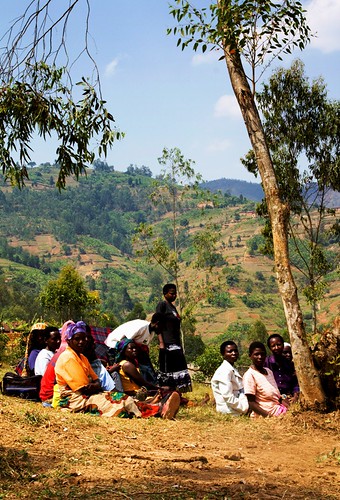
That Friday we met at WWI’s office and boarded a van, which drove about two hours south of Kigali. We stopped just off the main road near the top of a mountain. Above us a large group of women, a few hundred, standing, pacing, looking eagerly into our vehicle.

“They are excited you are here. They never get to see their sponsors. This is very rare," one of the trainers explained to me as I watched them watching me.
I sat in the vehicle for some moments. I got out. I stood and waited a few more minutes unsure of what was happening.

Then a trainer to my side smiled broadly, gestured behind me and said, “Here she is.”
I turned around and recognized Clementine from her picture. I opened my arms to embrace her and she pulled me flat against her, beating her arms against my back, resting her head on my shoulder. She held me for several moments muttering excitedly in Kinyarwanda.
“She says she is so happy to meet you,” the trainer translated beaming.

Clementine let go to look at me then held me again. She introduced me to her husband shyly standing next to her wearing a huge grin. He hugged me timidly and happily, thanking me in his language.
We walked to a shaded area away from hundreds of prying eyes and whispering lips. We spoke through an interpreter for some time, talking about each other’s families, our general lives. She apologized her children could not come; it was a two and a half hour walk and they were young. No, she hadn’t received my letter yet. I was a bit irritated; I had sent it last November.

Then Clementine offered a gift. In her hands lay a small green and white beaded box and a pink and black beaded necklace. I thanked her profusely. Her husband and she tied the jewelry around my neck. I wore a half smile, touched by the gesture, but anguished with guilt. She had sacrificed several dollars, probably as much as she makes in as many months to give me a present and in my haste I had brought her nothing. Others later assured me. It was a gift you coming to see her. It inspires.
She also offered to me two pictures of her family. I looked at them guessing they were the only ones she owned. I can’t take this.
“She wants you to remember her always,” the interpreter said. I put them in my purse appreciatively.
We embraced again and said goodbye. She asked if I could come for dinner. I said I couldn’t today, but maybe another. It was possible I would be in Rwanda again.

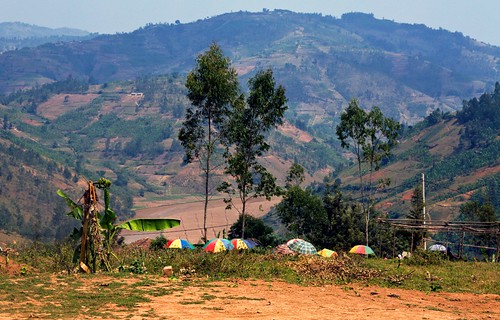
Clementine walked back towards the others as they broke off into the groups for the day’s lesson on nutrition. The women around us draped in bright colors, some shielded from the sun under rainbowed umbrellas continued to talk.


"Do you know what they are saying?” the trainer asked me.

“I have no idea.”

“They say it is a miracle. You coming. Her meeting her sister. They are very happy for her.”

I was humbled.

WWI participants and landscape


After the exercise the trainer boarded the van and smiled at me.

“I delivered your letter to Clementine today.”

We sat in silence.

Then Chiba muttered under her breath, “It is a miracle.”

I remained quiet; stared out the window; reflecting on an unforgettable day.
See all Rwanda pictures here.