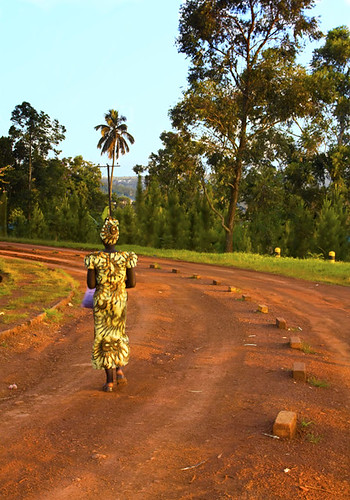
A woman walking at dusk along a sugar company road
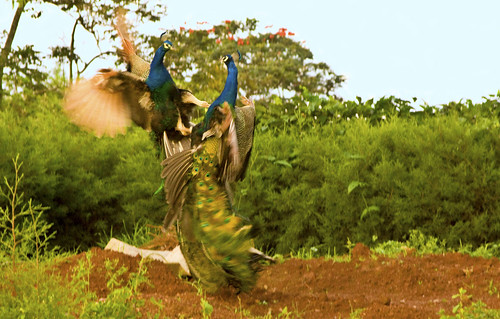
Fighting peacocks - the birds are brought from India and roam the plantation property
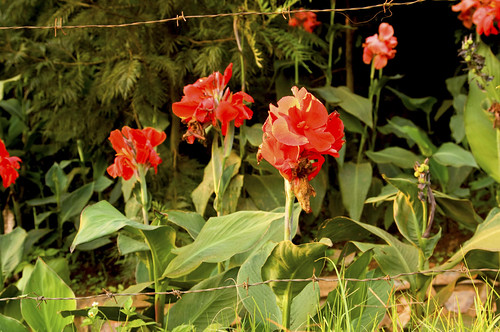
Flowering gardens are common along the central grounds
Factory at sunset

I was sitting in the shop one evening a few weeks ago when the normally quiet and unruffled Ester suddenly widened her eyes and told me she just remembered she needed to tell me something.
“Last night little Sylvia told me that the father used to inject them in the village.”
“What?” I said my eyes widening as big as hers.
She repeated herself. Then my head began spinning.
Into my mind flooded all the stupid things the father had done out of ignorance and poverty and possible madness. And into my mind also wandered the public service announcement I saw with Ester some months back on TV: a doctor cautioning a family against using the same needle when administering medication to different family members.
“Can you imagine one family using the same needle?” Ester had said laughing.
Yeah, now I could.
“I am guessing that the father reused the needles?” I asked Ester.
“Yeah, I asked the kids and they said he kept the same ones in the house.” I looked at her in disbelief.
“Did he use them on himself too?”
“That is what Sylvia said.”
I dropped my head into my hands. The father was HIV positive.
We had the two youngest tested for HIV the first day we took them in several months ago suspicious that they might be infected as the mother had recently passed from the disease and the little ones were so sick. Richard had also been tested in the summer prior to his surgery; all were negative.
“Okay. Tonight ask the kids the last time the father injected them. Be sure to ask them if he did it when they visited during Christmas. We need to rule out the possibility of him doing it since we took them last June.”
Ester nodded. She understood the importance of the time frame: HIV will sometimes not show up on tests until six months after becoming infected. Ester questioned the kids and to our relief they said the dad hadn’t injected them recently. Now it was time to test them.
So a couple of Saturdays ago as the three youngest, Rachel, Sylvia and Beatrice, played on the patio outside the Snack Shop in late morning sun, excited as usual to be at a shop they knew was established for them, their photos decorating the walls for all in town to see, Mama Ester finished a few tasks at the business before they departed for the hospital; the kids not knowing where they were going and what was about to happen.
“I’ll meet you here when you get back,” I said to her, anxious to get the results.
A couple hours later they returned, Ester climbing the shop’s steps with an even face, the girls in tow, the two youngest looking as if they recently shed tears.
“They are okay?” I asked uneasily. She nodded smiling.
“Good,” I sighed handing the little ones some pancakes for their troubles.
Meanwhile, Richard was having small procedure at the end of the week; the doctor was to remove a piece of bone for biopsy.
“Ask them for another HIV test while they are doing the procedure,” I told Ester.
A week later Richard and Ester returned from the hospital. Ester said the procedure went well, but the boy was in pain. I frowned; ineffective pain meds were all African hospitals could offer.
“Did they get the HIV results?” I asked her.
“Yes. He is negative.”
“Good,” I said deflating with relief.
Now it was time for Aggie’s test. I was concerned about my oldest since we recently had to chase off some boyfriends and previous to us taking her in, she had been chased off by her father to be married to an older man. It was becoming too difficult to coordinate taking her to the hospital without removing her from school, which she attended until the evenings Monday through Friday and half the day Saturday.
“We need to get Aggie tested now. We can’t keep putting this off. Let’s just take her to the lab here in town,” I finally said to Ester a few evenings ago. Soon thereafter Aggie showed up to the Snack Shop on her way home from school, darkness spreading against the sky.
“Aggie. Before you go home, you come with me,” I said to her. She followed me to the lab, sat down, and yelled and squirmed as the technician stuck the needle into the crook of her arm. I tried asking her about the recent running competitions at school to distract her. She had proudly announced to me when she saw me at the shop that she was selected to run on behalf of the school in a meet taking place in Mbale – a district about a four hour’s drive away.
“You got to go because you were the fastest?” I had asked excitedly. She smiled bashfully and nodded.
“Very good, Aggie!” I was very proud of her, never mind the fact that she was a sixteen year-old running against eleven year-olds.
But as the needle hung from her arm for several long moments she couldn’t remember why she was so excited about running for her school and getting to ride on a bus for probably the second time in her life, the first just a few months ago when she went to Entebbe as part of a class trip to see the zoo and airport, and I tried to forget for those long moments as the needle pulled her blood, watching red flood into the tube, why we were there in that eight by eight foot lab with the stinking latrines in the courtyard just outside, and I tried to forget for the thirty minutes thereafter, waiting dully for the test results, just as I had tried to forget all those previous weeks, this belittling my assurance, reproaching my peace of mind, and I didn’t realize how anxious I was until the little woman in the lab handed me the results and I looked down at the handwritten notes and ran outside, bounding across the center of town for some 50 yards, splashing through the soggy red soil, running up the crumbling shop steps, shoving the paper in Ester’s face, her brow furrowing as she read it aloud, “Agnes. Female. 16 years. Bloo-“
“No! Read the bottom!”
“HIV Negative!” She says her face spread in a huge smile.
“Yes! HIV Negative! They are all negative!” I practically yelled.
“Yes! That is so good! So good.”
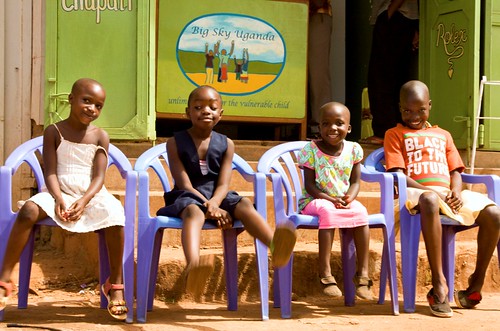
Kids playing at Shop before HIV tests - and yes, B2 is wearing a Black to the Future T-shirt! ;)


Anytime you do something for the first time there are bound to be mistakes made substantial and insignificant that make the first few steps of your new venture wobbly. You sort of stumble along initially with no small amount of adrenaline and energy surging you through your fresh undertaking with the anticipation that in a few months time your endeavor won’t take so much focus, that the bumps will smooth over with the knowledge you acquired through first-hand experience. New jobs, parenthood, traveling abroad, living in a new city, new co-workers, new circles of friends – they all take some getting used to and inevitably you will learn from them and unavoidably at times you will learn the hard way. Okay, now imagine all the things listed above sort of happening at once in a place so different you can’t believe you are still on the same planet.
Well, as my year in Uganda winds to a close in just a few short weeks, I am already starting to look back, kind of looking ahead preparing to look back, mentally accustoming myself to the huge shift that is about to take place, going from a place where I am constantly dirty and constantly different, am the focus of constant attention and the target of constant questions, I will become reacquainted with what was formerly familiar: cleanliness and anonymity, and a host of other things precious, most importantly family, friends, Western food, high speed internet, oh and of course wine.
Below are some of the lessons I’ve learned both great and small. For those of you thinking of moving abroad, especially to establish or manage a sustainable project, hopefully this post will make you all the wiser.
It is an ancient Mariner,
And he stoppeth one of three.
`By thy long grey beard and glittering eye,
Now wherefore stopp'st thou me?
1) Managing Tropical Diseases
If you start to feel under the weather, strange headache, stiff joints, unusually tired, diarrhea, go get a malaria test, but go to a good hospital preferably in Kampala rather than a local clinic or lab because the latter will almost always say you have malaria even if you don’t. For example, maybe the local lab will say, yes, you have malaria then treat you for it, but after you complete the treatment you still feel bad so then you go to the better hospital in the nation’s capital and they tell you, no, you don’t have malaria, you have another parasite, a thread worm, but you have to be careful because you can have something else and malaria, in fact many times you will have both since the two will work hand-in-hand weakening your immune system, and, of course, you can get malaria despite being on prophylactics. I've lost count, but I believe I’ve had positive malaria results somewhere around eight times now, two times I was so sick I ended up in the hospital and during my second hospitalization I had the pleasure of also having of H. pylori, an ulcer-causing bacteria, in addition to the severe malaria flare-up, so, really it’s actually advisable to also get full blood work and a stool sample along with the malaria test whenever you are starting to feel bad just to be sure.
"And now the storm-blast came, and he
Was tyrannous and strong:
He struck with his o'ertaking wings,
And chased us south along.
2) Managing Your Pocketbook
Get to know the costs of goods and services. Do all the purchases for your projects for some time yourself so that people you later leave in charge will have a more difficult time ripping you off. Ask people you know before you buy anything or take a boda or taxi anywhere how much they think the item or fare should cost because generally speaking when Ugandans see a muzungu they assume money magically grows from your hand and will attempt to overcharge you, sometimes in ways nothing short of ridiculous. At first this habit of fleecing might not annoy you so much and maybe you will take the stance that yes, I do have a lot more money than them relatively speaking, so it is somewhat fair, but then after you’ve been living with Ugandans for some time, sleeping under their roof, taking their food, laughing with them, commiserating with them, celebrating with them, mourning with them, forgetting oftentimes you are in fact a muzungu (maybe you’ll even catch a reflection of a fair arm in the rear view mirror of a car and think, what is a muzungu doing in here ? and then realize the reflection is of you) and so you feel like you are also a Ugandan in so many ways including that you like them do not have a job and have very little money and so the constant attempts to cheat you become offensive and tiresome and instead of thinking that such unofficial racially-based pricing policies are okay, you begin to think, but does Starbucks charge Bill Gates $10,000 for a latte just because he can afford it?
At length did cross an Albatross,
Thorough the fog it came;
As it had been a Christian soul,
We hailed it in God's name.
3) Managing Men
When strange men, including boda drivers, taxi drivers, or any of the scores of men just standing around or taking drink at the small bars in town want to talk to you, ignore them or politely, but quickly respond to their greetings while continuing to move. The first weeks I was here I would try and talk to everyone, but I quickly realized that 1) I would never get anywhere if I talked to everyone that wanted to speak with me because it is just too time-consuming, and 2) generally the strange men can be categorized as respectful, but not as good conversationalist and they will employ rather unoriginal tactics to accomplish their two objectives: sleeping with you and parting you with your money, and while they have been entirely unsuccessful with me in both attempts, their aims become exceedingly clear and boring after a short while.
And a good south wind sprung up behind;
The Albatross did follow,
And every day, for food or play,
Came to the mariner's hollo!
4) Managing Sustainable Projects
I had heard it was difficult, extremely so, to establish successful sustainable project in
When setting up sustainable projects, and I would imagine through the entire course of administering them, operate with extreme skepticism of all people involved regardless of how sincere they are, how much they may sweet talk you, particularly if those assisting you with the project administration and management are not direct beneficiaries; in fact, assume these people are always looking to take something on the side for themselves in addition to whatever you agree with them openly. And never, under any circumstances have one person or a group of people who know each other be responsible for everything, including finances, reporting, oversight, management, etc. There must, must, MUST be layers of accountability and no one point of contact. To be sincere, charities here regardless of the size and level of funding are viewed as gold mines. Working for a charity in
I just had the pleasure of meeting an American woman who set up a charity that operates as a support group for AIDS/HIV orphans. A wonderful woman with a big heart decided to try and offer support to children affected by HIV some nine years ago, but for some reason or another, and candidly I think rather foolishly, hadn’t come to visit her programs in person in as long. And over the course of the last nearly decade she has had one person responsible for running her organization, one person responsible for receiving the money and in-kind donations for the kids, one person reporting to her results and finances, etc. and as she sat describing to me the things she has seen during her less than two-week trip, including some weird situation with an interpreter that her one contact insist they use and finding half the boxes of clothes she had shipped to him for the kids still sitting in his home, I just shook my head and told her that this guy she has left in charge of everything is just stealing from her and she needs to slowly take all control away from him, completely reorganize, take inventory, consult an attorney and not send this one guy working for her anything in the meantime, but that she also shouldn’t confront him or act like she is suspicious of him as he will probably bolt and take all of her organization’s possession, including a car, microscope, computer, etc. with him. I didn’t tell her that the little work she did see while here, the orphans’ meeting she attended, one of the meetings that has supposedly been taking place regularly these last nine years could very well have been a shame, the kids not really beneficiaries of her program and this guy could have just told the villagers to bring some kids together for the visiting muzungus to look at and they wouldn’t know any different because of the language barrier. And at the end of my conversation with her I thought, God, I’ve made some mistakes, but at least I figured it out in a month and not nine years!
`God save thee, ancient Mariner,
From the fiends that plague thee thus! -
Why look'st thou so?' -"With my crossbow
I shot the Albatross."
5) Managing School
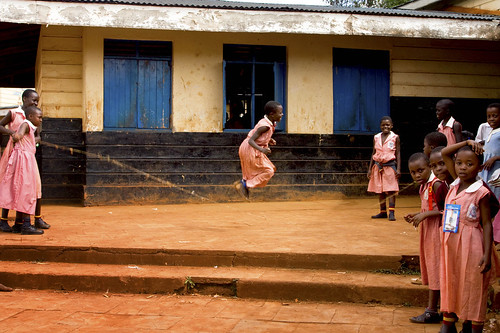
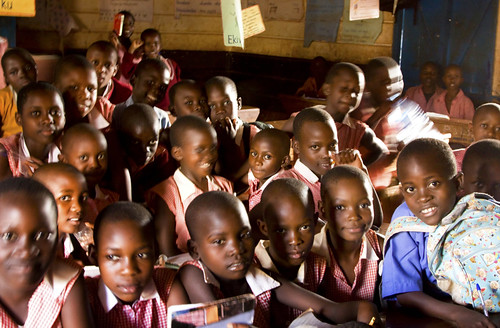
When it comes to school for kids under your care there are some things you should keep in mind. First, buy them sturdy black sneakers that Velcro and not the standard patten-leather school shoes because all the wear and tear coupled with the Ugandan red dirt and mud means the non-sneakers fall apart very easily, buckles crumpling apart, soles ripping to shreds, toes poking through holes, and require the constant annoyance of repair and polishing. Second, go talk to the kids’ teachers so that they might give more attention to your children. Your children are just a few in classrooms of scores, at times a hundred kids; one of many little bodies squeezed into hot, airless rooms crowded together on wooden benches, hand-made posters with lessons hung from the concrete walls, all the children looking the same in their school uniforms scribbling in small, flimsy exercise books with broken pencils with just one teacher trying to dictate lessons; if you want your child to have a bit more of an edge in learning, go talk to that teacher.
"The sun now rose upon the right:
Out of the sea came he,
Still hid in mist, and on the left
Went down into the sea.
6) Managing Wishes
If you are looking after children who were once destitute and often without basic living requirements, they will find happiness in and be thankful for the smallest things you give them, and although they are never demanding or act entitled, in fact, hardly ever even ask you for anything, they do, nonetheless, enjoy their new lives and its new benefits so much so that maybe at times your four-year old, having spent the afternoon with you in your snack shop, keeps telling you she is hungry despite just being fed an entire plate of food complete with meat, matoke, nakati, rice and beans for lunch, despite also just being given a pancake (a fried sweet made of cassava flour and ripe bananas), despite also just being given a cowpea samosa (a fried pocket filled with cowpeas, which are like big lentils), know that your child is just trying to eat as possible because her previous life didn’t include so much food and delicious food prepared and bought in town at that, her previous diet probably consisting of just boiled cassava and roasted maize from her family’s garden, and as much as you love her you turn to her and smile and tell her, No, Rachel. Your Mommy knows you are not hungry, do you want water instead? And oftentimes she will say, Yes, is water, because she still doesn’t quite grasp English well enough to properly ask for things and because, well, she just likes you giving her something, mostly, attention. Which bring me to one of the most important things I’ve learned here so far….
7) In a Word
There are so many, many children here – products of consistently one of the highest fertility rates in the world, about seven children per woman – it is impossible to step outside here in Uganda and not see so many children and all of them responding in very noticeable ways to your very noticeable muzungu presence. And all those children giggling and screaming and greeting you are at times without shoes and aren’t in school and don’t get all the food and medicine they need and drink dirty water from wells and springs and play in fields of filth with toys of trash – balled up plastic bags and old bicycle tires, smashed water bottles and bent bottle caps. And these dirty, shoeless, undernourished and poorly educated children, believe it or not, despite lives of poverty as we would describe it, are incredibly, inspiringly joyful. In fact, Ugandan children are in my humble opinion generally happier than American kids who are blessed with proper nutrition and regular schooling and modern medicine and modern homes and mattresses and toys and TVs and Segas - children who have everything in some senses, but little to none in others.
Water, water, every where,
And all the boards did shrink;
Water, water, every where,
Nor any drop to drink.
Of course extreme circumstances like drought and war and natural disasters and the like withstanding, African children are refreshingly content and beautifully resilient despite their relative lives of need and want and I can only conclude that their happiness is an outcome of their culture of inclusion: African children are a part of expansive African families and clans and tribes giving them a sense of belonging, a sprawling context and substantial support to their lives. And in seeing so many glad, but “poor” children, I have learned what a child really needs to live successfully, more than food, water, clothes, shelter, medicine, or educations. A child really, truly, deeply needs more than any one other thing essentially is love.
He prayeth best, who loveth best
All things both great and small;
For the dear God who loveth us,
He made and loveth all."
The Mariner, whose eye is bright,
Whose beard with age is hoar,
Is gone; and now the Wedding-Guest
Turned from the bridegroom's door.
He went like one that hath been stunned,
And is of sense forlorn:
A sadder and a wiser man
He rose the morrow morn.
They say you can’t travel thorough time, but I can and do all of the time, actually oftentimes moving forwards and backwards at once, my head spinning with thoughts on what has happened and what is about to occur. I engaged in this type of time warp in my old space, during my time in the fast-paced West where unlike here most people think of all times except the present, spending most of their time lagging in the past and accelerating into the future. And as I am just about to reenter that old space that mixes the former and the following, as I verge on breaking the time-space continuum, I find that I am no longer thinking of only the present here and now, which I have been doing for some time, for these many months; I am preparing as it were to leave this space and return to the future, and I find myself more and more of the time thinking of exactly that, moving back and forth.
Nearly a year has passed since I came to
Thinking back to the children they were when we found them, sometimes I want to laugh. Rachel the first few months we had her took to opening and shutting doors in the Balaza’s home over and again, me realizing later that she engaged in this rather annoying habit because the kids’ home and those they visited in the village didn’t have doors, opening and closing a door was in fact for her an endlessly fascinating form of entertainment. And fast-forwarding to now, likewise the three youngest girls to this day insist on bathing at their jaaja’s (grandparents) because the house has a shower head, which still doesn’t yield hot water, but a shower head nonetheless, which the children stand under squealing and splashing, revealing in the novelty of (sort-of) modern plumbing.
Thinking back to the children they were, sometimes I want to cry. Despite knowing that their lives have altered drastically, the images of those five desperate faces in the village that me, Ester, Aunt Vinnie and Sumete first found last June still haunt my mind, the past lingering into the present pressing ominously against the future. I see those faces again in my memory, in recalling what was, and am reminded of them, and what still is, at times when I turn on the TV, floating before my eyes again in the aftermath of earthquakes and famines, floods and wars, tiny faces that are at once tense and apathetic, shocked and hopeless, ruined from the past, tortured in the present, uncertain of the future; I knew those faces before, didn’t understand them until now, and will commiserate them forever going forward: those are the young faces of trauma.
And in thinking ahead, imagining the lives we will lead, me and my children, sometimes I am excited; for me to be back in the comforts of modern society and the like-minded, to be clean and understood, to be healthy and heard, to eat well and to be anonymous, for that I am anxious; and for them to continue their lives with the comforts that Africa can at the very least offer: regular food, clean water, educations, something that passes for health care and, most importantly, love.
And in thinking ahead, imaging the lives we will lead, me and my children, sometimes I am scared. Will I be able to catch the things that fade and fall through time and space? Will the children be forced back into their dark pasts if not for bright futures? What will remain when dreams and expectations, intentions and understandings are entangled in the circles of backwards and forwards in the gaps of here and there? I think back, I think ahead, my mind racing out of the past and into the future, who I was, who I will be, who they have been, who they will become; I consider, I dream, I hope, I wonder…time after time…
After my pictures fades
And darkness has turned to grey
Watching through windows
You’re wondering if I’m okay
Secrets stolen from deep inside
The drum beats out of time
If you’re lost
You can look
And you will find me
Time after time
If you fall
I will catch you
I’ll be waiting
Time after time
Time after time
Time after time
After living with Africans for nearly a year I was beginning to feel trapped in a wonderland; a wonderland of surreal characters speaking another language, some there to genuinely help me, others to genuinely hurt me, but all completely, utterly ununderstandable, their words at time falling on my ears like jibberish. I had to get away for a few days. I was finally, just absolutely having it – having it with Africans and their bizzare ways. I needed to step outside the looking-glass, outside the closing in absurdity that was Africa, outside my projects and their web of problems and regroup, refocus, re-energize; gain a brighter, bigger , more beautiful perspective. I felt myself growing hard, weighted, cynical; I felt trapped on the other side of a looking-glass.
The time has come," the Walrus said,
"To talk of many things:
Of shoes—and ships—and sealing-wax—
Of cabbages—and kings—
And why the sea is boiling hot—
And whether pigs have wings."
So I spent a few days at The Red Chili Hideaway – a compound just outside of
Their stories were fascinating, invigorating, inspiring and soothing; swapping tales and thoughts with the aid workers was particularly therapeutic:
Yes, you just need to get away sometimes; it’s the only way to cope. Yes, you grow a bit hard, not entirely befriending the people around you. Yes, everyone is always trying to get something from you. Yes, it’s hard going back home; nobody else quite understands what you’ve been through. Yes, development books can’t really teach you about how to run sustainable projects. No. No. I don’t know what I am doing in a few weeks when my project is over either. I’ll figure it out when I get home. I don’t know what kind of life I want anymore.
And so it was. A gated compound filled with Western food, a miniature swimming pool, dorms, tents, flushing toilets, beat-up vehicles, and, most importantly, people who spoke the same language, who had the same dreams, fears, passions, challenges, hopes, worries, aspiration, uncertainties, highs and lows; a walled-in sanctuary, a brief encounter with serenity and understanding. But. Then. Back to the ridiculous and the duplicitous looming outside…
“O Oysters,” said the Carpenter,
“You had a pleasant run!
Shall we be trotting home again?”
But answer came there none—
And this was scarcely odd, because
They’d eaten every one.
But going back through the looking-glass this time I felt more at peace, more in piece, with a clearer perspective like glass perfectly cleaned remembering all of the good and not just the bad around me, and my conversation with my real family waiting patiently in California, just six more weeks and you’ll be home!, as always offered important reminders; you’ve helped so many people already, you have to expect some of these things are going to happen, even major corporations suffer losses.
And, as always, the best reminder was the children. Despite anything else going on, stealing, cheating, lying, backstabbing, rumors, gossip, power-plays, insincerity, lapses in logic, lapses in integrity, I can always, always find solace and happiness in the kids, their laughter, honesty, purity and genuine gratitude are a constant source of strength and joy.
“Sylvia. Put on your new uniform so I can take a picture,” I asked my eight year old yesterday after returning from Red Chili, my little girl who didn’t know a single letter or digit when we took her in last summer and within a period of a few months learned enough to spell simple words and complete basic arithmetic; I was incredibly proud of her as she was of herself. She had been advanced from nursery school to primary school after one three month term and I knew she loved her new, big-girl school’s red and white gingham uniform.
Sylvia ran inside the house to put on the dress then me and her and the rest of the kids played and laughed in the late Sunday sun before I slipped to the children’s village with Aunt Jennifer to check on the land we had cleared and planted on behalf of the kids to ensure their food security when I leave in just a few weeks; happy children, growing food, bright futures… I felt okay despite all the troubles, all the absurdity...
The sun was shining on the sea,
Shining with all his might:
He did his very best to make
The billows smooth and bright--
And this was odd, because it was
The middle of the night.

There are fewer things more difficult in life than finding yourself caught in a set of circumstances that force you to operate in a fashion that goes against your very nature, to find yourself confined in a situation that at once highlights the characteristics that comprise you at your core and also forces you to control or alter those defining qualities; it is a challenge of one’s strength, will, fortitude, resourcefulness and ingenuity.
Say, for example, you have been moving through your life, your entire life thus far, going to school, getting a job, starting a family, retiring, becoming grandparents, and so on, playing out patterns of existence, and then one day, like a shocking jolt, you realize it’s all a ruse and actually nothing was as you had always perceived it: rather than individuals carving unique paths, you were drones following a nefarious plan; you and everyone you knew were not people in cycles, but a cogs in wheels; you were not living a life, but stuck in a matrix.
How do you pull yourself out of the matrix? Could you even have the correct set of tools to guide you? Everything you knew until just now was just wrong. Maybe you would ignore the new found reality, pretend that you didn’t know - that everything was as it had always been? Maybe you would just hope that things would continue as they had, as if they didn’t require some kind of massive, scary change for everything to be right.
For those of you who might have been on this site a few days ago and now see, strange, a missing entry, no, your eyes are not deceiving you, and no, there is not a glitch in the matrix. In fact, I had posted a blog some days ago, but the evil machines are again looking for any opportunity to separate the muzungu from her money and some of those machines are at least partially computer literate and know this website; as such, the post was removed as it is not the time to reveal any information on the matrix that could be used against me.
So what is so difficult here? Everything and nothing. Like the matrix, most people here are not what they seem – you have to look closely, find the patterns and inconsistencies to know the truth. Everything can come crashing down if not played properly, and so I move with caution to ensure the machines will not continue to suck energy from me and my projects, but I have confidence as I have swallowed the little red pill of truth and have learned my true nature and how to control it… and so, yes, I am now for the remainder of my time here in an alternate reality, wholly untrusting.


 Posts
All Comments
Posts
All Comments